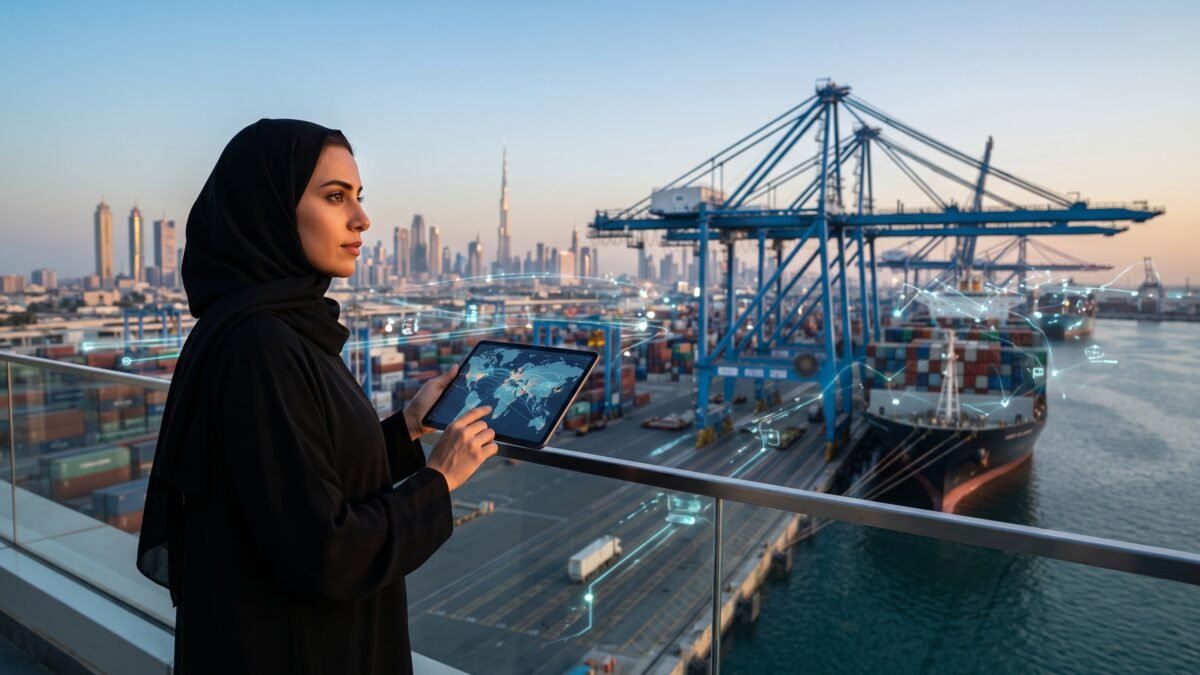
By mid-2026, the landscape of trade across the Gulf Cooperation Council (GCC) has moved far beyond the traditional reliance on physical geography. While the region’s position at the crossroads of East and West remains its primary asset, the real competitive edge is now found in the “invisible” layer of digital infrastructure. From the automated berths of Jebel Ali to the hyper-connected logistics hubs of NEOM’s Oxagon, the integration of 5G-Advanced, artificial intelligence, and unified digital customs platforms is fundamentally altering how goods move across borders.
For decades, trade in the GCC was defined by massive capital expenditure on physical assets—deeper harbors, larger airports, and expansive road networks. However, as we navigate 2026, the focus has shifted toward maximizing the efficiency of these assets through data. The objective is clear: to reduce the “friction” of trade. In a world where global supply chains are increasingly volatile, the ability of Saudi Arabia, the UAE, Qatar, and their neighbors to offer a seamless, paperless, and highly predictable logistics environment has become a cornerstone of their non-oil economic strategies.
This evolution is not merely about speed; it is about resilience and transparency. Business owners and logistics providers now operate in an ecosystem where a shipment’s journey from a factory in Shenzhen to a warehouse in Riyadh is tracked, cleared, and financed through integrated digital corridors. This shift is creating significant opportunities for SMEs and tech-driven startups while forcing traditional logistics players to rapidly modernize or risk obsolescence.
The Rise of the National Single Window and Regional Interoperability
One of the most significant contributors to enhanced trade efficiency in 2026 is the maturity of “National Single Window” (NSW) systems. These platforms serve as a centralized digital entry point for all trade-related regulatory requirements, bringing together customs, port authorities, health ministries, and chambers of commerce into a single interface.
In Saudi Arabia, the Fasah platform has evolved into a sophisticated ecosystem that utilizes AI to predict peak congestion times and automate risk assessments. Similarly, the UAE’s Advanced Trade & Logistics Platform (ATLP) has streamlined the documentation process for thousands of businesses in Abu Dhabi and beyond. The impact on the bottom line for businesses is measurable. By digitizing the “bill of lading” and certificates of origin, the time required for customs clearance in many GCC ports has dropped from days to mere hours.
The current challenge—and the primary focus for 2026—is regional interoperability. While each GCC state has made immense strides individually, the goal is to create a “GCC Digital Trade Corridor.” This involves ensuring that a digital document issued in Oman is recognized and processed seamlessly by customs authorities in Kuwait or Bahrain. The technical alignment of these systems is reducing the administrative burden on cross-border trucking and maritime trade, making the “GCC as a single market” more of a reality than ever before.
AI and Predictive Logistics: Beyond the Hype
In 2026, Artificial Intelligence (AI) has moved from experimental pilots to the operational core of GCC logistics. For a region that experiences extreme weather conditions and high cooling costs for perishable goods, AI-driven predictive analytics are a necessity rather than a luxury.
Large-scale operators like DP World and AD Ports Group are utilizing AI to optimize container stacking and crane movements. By analyzing historical data and real-time shipping schedules, these systems can predict which containers need to be accessed first, reducing energy consumption and turnaround times. For the private sector, this translates to lower port fees and more reliable delivery windows.
Furthermore, AI is playing a critical role in demand forecasting. Retailers in the UAE and Saudi Arabia are increasingly using regional data pools to predict consumer trends, allowing them to position inventory closer to the end-user before an order is even placed. This “anticipatory logistics” is supported by a digital infrastructure that can handle massive data throughput, ensuring that the supply chain is proactive rather than reactive.
5G-Advanced and the Internet of Things (IoT) in Port Operations
The rollout of 5G-Advanced (often referred to as 5.5G) across the GCC has provided the high-bandwidth, low-latency connectivity required for truly autonomous logistics. In 2026, we are seeing the widespread adoption of IoT sensors on a granular level. It is no longer just about tracking a container; it is about monitoring the temperature, humidity, and vibration levels of individual pallets within that container.
Key Applications of IoT in GCC Logistics:
- Cold Chain Integrity: For Qatar and Saudi Arabia’s growing pharmaceutical and food security sectors, IoT sensors ensure that sensitive goods remain within strict temperature ranges throughout their journey across the desert.
- Asset Utilization: Fleet management companies in Oman and Kuwait use real-time data to optimize routes, reducing fuel consumption and carbon emissions—a key requirement as ESG (Environmental, Social, and Governance) mandates become stricter.
- Autonomous Ground Vehicles (AGVs): In the ports of Khalifa and King Abdullah, 5G-powered AGVs move containers with centimeter-level precision, operating 24/7 without the need for human intervention in high-risk or high-temperature zones.
This level of connectivity allows for the creation of “Digital Twins” of entire ports and logistics parks. Decision-makers can run simulations to see how a sudden influx of cargo or a shift in shipping lanes will affect their operations, allowing for better resource allocation and infrastructure planning.
Blockchain and the Tokenization of Trade Finance
Access to liquidity has historically been a bottleneck for SMEs involved in cross-border trade. In 2026, digital infrastructure is solving this through blockchain-based trade finance platforms. By creating an immutable record of a transaction—from the purchase order to the final delivery—banks and fintech lenders can assess risk more accurately.
In the UAE and Bahrain, the regulatory environment has encouraged the growth of platforms that “tokenize” invoices. This allows a small business in Manama to receive immediate payment for a shipment headed to Dubai, with the digital record acting as collateral. This democratization of trade finance is essential for the GCC’s goal of increasing the contribution of SMEs to the total GDP.
Moreover, blockchain is being used to verify the provenance and sustainability of goods. As European and Asian markets demand more transparency regarding the carbon footprint of imported products, the GCC’s digital trade infrastructure provides a verifiable “green record.” This is particularly relevant for the region’s petrochemical and aluminum exports, which are under increasing scrutiny in the global transition to a low-carbon economy.
The GCC Railway: A Digital-First Mega Project
As the physical tracks of the GCC Railway continue to connect the six nations, the “digital layer” of this project is proving to be just as important as the steel and concrete. By 2026, the railway is being positioned as a smart corridor. Unlike older rail networks in other parts of the world, the GCC Railway is being built with integrated fiber optics and sensors from day one.
This digital integration allows for:
- Unified Signaling: Ensuring that trains can cross borders without changing locomotives or systems, a common delay in international rail.
- Real-Time Cargo Visibility: Shippers can track their goods across the entire peninsula through a single dashboard, regardless of which national rail authority is handling the transport.
- Predictive Maintenance: Sensors on the tracks and rolling stock identify potential failures before they occur, minimizing downtime in the harsh desert environment.
The railway acts as a massive data pipe, connecting the industrial cities of Saudi Arabia’s Eastern Province with the ports of Oman and the UAE, creating a multimodal logistics network that is significantly more efficient than traditional trucking.
Challenges: Cybersecurity and the Human Element
Despite the rapid progress, the transition to a fully digital trade environment is not without risks. The primary concern in 2026 is cybersecurity. As trade becomes more dependent on interconnected digital systems, the “attack surface” for cybercriminals and state-sponsored actors grows. A disruption to a National Single Window or a major port’s automated system could paralyze a nation’s economy within hours.
GCC governments are responding by implementing strict data residency and cybersecurity laws. For businesses, this means that investing in digital infrastructure also requires a proportional investment in cyber-defense. The “human element” also remains a challenge; there is a significant demand for logistics professionals who are equally comfortable with supply chain management and data science.
Furthermore, the interoperability of standards remains a work in progress. While the technology exists to connect systems, the legal and regulatory frameworks—such as data-sharing agreements and cross-border liability—require ongoing diplomatic and commercial negotiation.
Opportunities for Investors and Technology Providers
The digital transformation of GCC trade is creating a fertile ground for investment. Foreign technology companies are finding opportunities in providing the niche solutions required for the region’s unique environment.
- Cyber-Physical Security: Companies specializing in securing IoT devices and industrial control systems are in high demand.
- AI for Arid Climates: Solutions that optimize energy use in refrigerated logistics (cold chain) are particularly valuable.
- EdTech and Training: There is a massive market for platforms that can upskill the existing logistics workforce in digital competencies.
- Fintech: Startups focusing on cross-border B2B payments and automated escrow services are seeing increased interest from regional VC firms.
For business owners, the message is clear: the digital infrastructure is no longer a “future trend”—it is the current baseline. Companies that fail to integrate their internal systems with the national digital trade platforms will find themselves facing higher costs and slower turnaround times than their “digital-native” competitors.
The Outlook for Late 2026 and Beyond
As we look toward the end of 2026, the focus will likely shift toward the integration of Quantum Computing for complex logistics optimization and the use of Low Earth Orbit (LEO) satellites to provide connectivity for remote desert transport routes. The GCC is already positioning itself as a testbed for these technologies.
We should also watch for the potential launch of a GCC-wide Digital Passport for Goods, which would further simplify the movement of products between member states. This would move the region closer to the “seamless border” model seen in the European Union, but with a uniquely digital-first approach.
The ongoing investments in Saudi Arabia’s Vision 2030 and the UAE’s D33 economic agenda are not just about building cities; they are about building the digital connective tissue that will sustain those cities. For the GCC, digital infrastructure is the new “Silk Road,” and those who understand how to navigate its data-driven lanes will be the winners in the global trade economy.
Conclusion: Navigating the New Digital Reality
The enhancement of GCC trade through digital infrastructure is a fundamental shift that affects every level of the economy. From the micro-entrepreneur in Muscat using a digital platform to export handmade goods, to the multinational corporation managing a complex distribution hub in Dubai, the benefits of reduced friction and increased transparency are undeniable.
However, this new era requires a change in mindset. Logistics is no longer just about moving boxes; it is about managing data. Businesses must prioritize digital integration, cybersecurity, and talent development to remain competitive. As 2026 progresses, the gap between digitally mature companies and those lagging behind will only widen. For the GCC, the path to becoming a global logistics powerhouse is paved with data, and the journey is well underway. Readers should watch for further announcements regarding GCC-wide data-sharing protocols and the continued expansion of autonomous transport corridors as the next major milestones in this transformation.