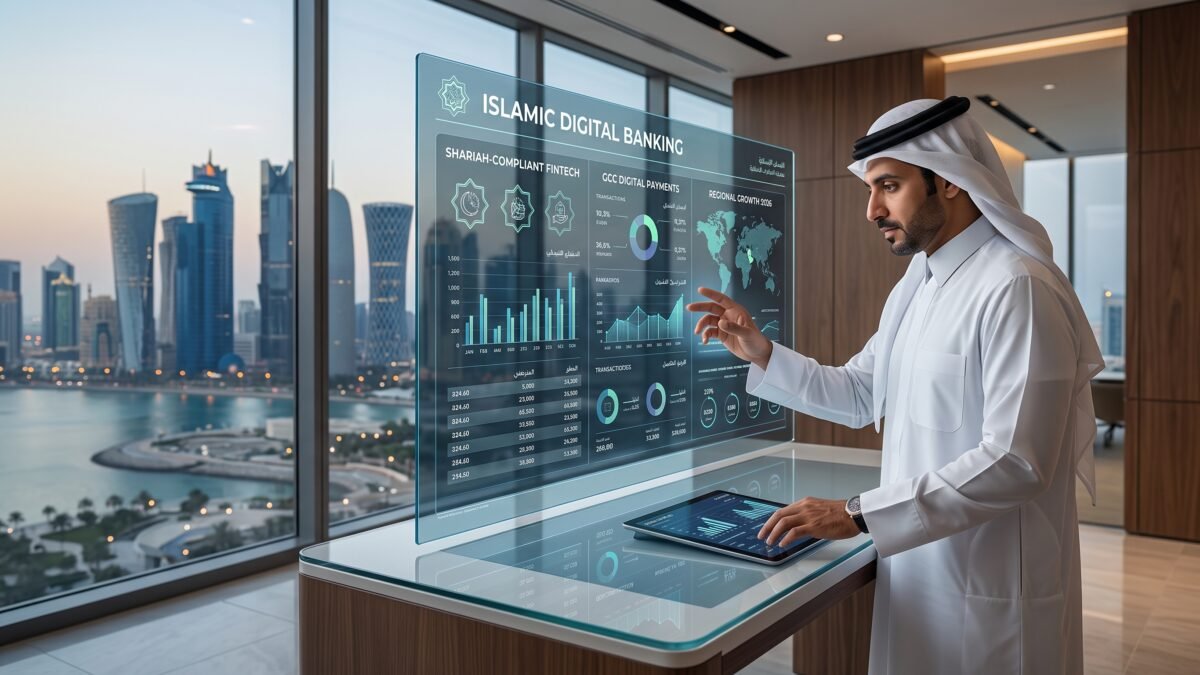
By the midpoint of 2026, the distinction between “traditional” Islamic banking and “digital” Islamic banking has largely evaporated across the Gulf Cooperation Council (GCC). What were once experimental pilots in 2022 and 2023—such as blockchain-based Sukuk or AI-driven Sharia auditing—have become the operational baseline for institutions from Riyadh to Muscat. For the GCC’s financial sector, 2026 represents a pivotal year where technology is no longer an add-on; it is the primary vehicle through which the ethical and asset-backed principles of Sharia finance are delivered to a hyper-connected population.
The transformation is driven by a unique confluence of factors: the aggressive execution of Saudi Arabia’s Vision 2030, the UAE’s push toward a decentralized digital economy, and a demographic shift where the “digital native” generation now dictates market demand. For business owners, investors, and technology providers, understanding these shifts is no longer optional. The Islamic banking sector in the Gulf is currently outpacing its conventional counterparts in digital adoption rates, fueled by a desire to bridge the gap between ancient ethical mandates and futuristic financial requirements.
Generative AI and the Automation of Sharia Compliance
One of the most significant shifts witnessed in 2026 is the integration of Generative AI (GenAI) into the core of Sharia governance. Historically, the process of ensuring a financial product was Sharia-compliant involved lengthy manual reviews by Sharia boards, often leading to slower time-to-market for new products. Today, sophisticated Large Language Models (LLMs) trained specifically on Islamic jurisprudence (Fiqh al-Muamalat) are acting as first-line auditors.
These AI systems can scan thousands of pages of contracts, investment portfolios, and transaction records in seconds to flag potential non-compliance issues such as Riba (interest) or Gharar (uncertainty). In Saudi Arabia and the UAE, leading Islamic banks are using these tools to provide real-time compliance certificates for complex corporate financing deals. This does not replace the human Sharia scholar; rather, it empowers them to focus on high-level ethical interpretation while the AI handles the data-heavy verification.
For the customer, this translates to “instant” Sharia-compliant personal loans or business credit lines. The friction that once characterized Islamic finance is disappearing, making it as agile as any global fintech offering. The competitive advantage in 2026 lies in the speed of compliance. Banks that have successfully automated these workflows are capturing a larger share of the SME market, where rapid access to capital is a survival requirement.
The Rise of Tokenized Sukuk and Fractional Ownership
The Sukuk (Islamic bond) market has undergone a radical restructuring thanks to distributed ledger technology (DLT). In 2026, we are seeing the widespread “tokenization” of Sharia-compliant assets. This trend is particularly prevalent in the real estate and infrastructure sectors of Qatar and the UAE. By breaking down a large asset—such as a commercial tower in Dubai or a solar farm in Neom—into digital tokens, banks are enabling retail investors to participate in institutional-grade investments with as little as $500.
This democratization of Islamic capital is solving a long-standing liquidity issue in the Sukuk market. Previously, Sukuk were largely the domain of institutional players due to high entry costs and complex documentation. Tokenization automates the profit-sharing distribution through smart contracts, ensuring that payments are made instantly and transparently to token holders as soon as the underlying asset generates revenue. This aligns perfectly with the Sharia requirement for asset-backing and risk-sharing.
- Secondary Market Liquidity: Digital exchanges in the Abu Dhabi Global Market (ADGM) and the Dubai International Financial Centre (DIFC) now host active secondary markets for these tokens, allowing investors to exit positions with ease.
- Reduced Issuance Costs: For GCC governments and corporates, the cost of issuing a tokenized Sukuk is significantly lower than traditional methods, as it removes multiple intermediaries.
- Transparency: Blockchain provides an immutable audit trail, which is essential for maintaining the trust of Sharia-sensitive investors.
Open Banking 2.0: The GCC’s Integrated Ecosystem
Open Banking has moved beyond the “regulatory mandate” phase into a mature “value-creation” phase. In 2026, the Central Bank of Saudi Arabia (SAMA) and the Central Bank of the UAE (CBUAE) have fostered an environment where Islamic banks are sharing data securely with third-party fintechs to create “lifestyle” financial ecosystems. This is more than just viewing all your accounts in one app; it is about embedded Islamic finance.
For example, a consumer in Kuwait looking for a new car can now secure Sharia-compliant Murabaha financing directly within the car dealership’s app. The bank’s API (Application Programming Interface) verifies the user’s creditworthiness and Sharia-eligibility in the background, completing the transaction without the customer ever visiting a bank branch. This “invisible banking” model is becoming the standard for retail and SME sectors across the Gulf.
Furthermore, we are seeing the emergence of a cross-border GCC Open Banking framework. A business owner in Bahrain can now use their local credit history to access Islamic financing from a lender in Oman, thanks to standardized data protocols. This regional integration is a massive boon for GCC-based startups looking to scale across the six nations without the burden of fragmented financial silos.
The Convergence of ESG and Maqasid al-Sharia
In 2026, the alignment between Environmental, Social, and Governance (ESG) criteria and the Maqasid al-Sharia (the higher objectives of Sharia) has become a primary driver of investment strategy. Islamic banks in the Gulf are no longer just avoiding “sin stocks” like tobacco or gambling; they are actively seeking “impact” investments that promote social welfare and environmental sustainability.
This trend is highly visible in the “Green Sukuk” market. Saudi Arabia’s Public Investment Fund (PIF) and various Emirati entities have issued record-breaking amounts of green Sharia-compliant debt to fund renewable energy projects. Digital platforms now allow investors to track the specific impact of their money—such as the exact amount of carbon offset or the number of jobs created—in real-time via their banking dashboard.
“The 2026 Islamic banker is as much a data scientist and an ethical auditor as they are a financier. The goal has shifted from mere compliance to the proactive creation of social value through digital transparency.”
For GCC business owners, this means that securing Islamic financing now often requires meeting certain sustainability benchmarks. Banks are offering lower profit rates for companies that can demonstrate high ESG scores, effectively using digital tools to incentivize a greener regional economy.
Neobanks and the Digital-First Islamic Experience
The landscape is now populated by several pure-play digital Islamic banks that have no physical branches. In Saudi Arabia, entities like D360 and STC Bank have forced traditional giants to rethink their entire service model. These neobanks are winning the battle for the youth demographic by offering a user experience that mirrors social media platforms rather than traditional banking portals.
These digital-first players are utilizing “Hyper-Personalization.” Using machine learning, these banks analyze a customer’s spending patterns to offer proactive financial advice that is Sharia-compliant. If a customer is spending heavily on dining, the app might suggest a Wakala-based savings plan to help them reach a future goal, such as Hajj or a home down payment. This shift from transactional banking to “financial coaching” is a hallmark of the 2026 market.
Traditional banks have responded by launching their own digital “flanker brands” to protect their market share. The result is a highly competitive environment where the consumer benefits from lower fees, better profit-sharing ratios, and superior technology.
Cybersecurity and the Sharia Implications of Data
As Islamic banking becomes entirely digital, the risks have scaled accordingly. Cybersecurity is the top priority for GCC regulators in 2026. However, in the context of Islamic finance, data privacy is increasingly being framed as an ethical obligation under the concept of Amanah (trust). A breach of customer data is not just a regulatory failure; it is seen as a violation of the ethical bond between the bank and the client.
The use of “Sovereign Clouds” has become mandatory in countries like Saudi Arabia and the UAE. This ensures that the financial data of GCC citizens remains within national borders, protected by local laws. Banks are also deploying AI-driven “threat hunting” tools that can identify and neutralize cyber-attacks before they penetrate the core banking system. For the business community, this focus on security is essential for maintaining the integrity of the digital trade ecosystem.
Challenges: The Talent Gap and Regulatory Divergence
Despite the rapid progress, 2026 is not without its hurdles. The most pressing challenge is the “Double-Specialist” talent gap. There is a severe shortage of professionals who are deeply versed in both advanced financial technology (like blockchain and AI) and the intricacies of Sharia law. Educational institutions in the GCC are rushing to create hybrid programs, but the demand currently far outstrips the supply.
Another challenge is the occasional divergence in regulatory standards across the GCC. While there are moves toward harmonization, a product approved by the Sharia board in Dubai might still face hurdles in Kuwait or Qatar due to differing interpretations of certain contracts. For fintechs operating across the region, navigating these subtle legal nuances remains a significant operational cost.
What Businesses and Investors Should Watch Next
As we move through 2026 and look toward 2030, several emerging areas will define the next phase of this digital transformation:
- Central Bank Digital Currencies (CBDCs): Watch for the full integration of the Digital Dirham and Digital Riyal into Islamic wholesale markets. This will revolutionize cross-border Sharia-compliant settlements, making them instantaneous and nearly cost-free.
- The Metaverse and Virtual Banking: While still in the early stages, some GCC Islamic banks are establishing virtual presences to provide financial education and advisory services to a younger generation that spends significant time in immersive digital environments.
- AI-Driven Wealth Management: Expect “Robo-Advisors” to become the primary way the GCC middle class manages its wealth, with algorithms automatically rebalancing portfolios to ensure they remain Sharia-compliant as market conditions change.
- SME-Specific Islamic Fintech: Look for platforms that solve the “working capital gap” for small businesses using Istisna (manufacturing finance) or Salam (advance payment) contracts, fully automated via digital platforms.
The Strategic Takeaway
The digital transformation of Islamic banking in the GCC is no longer a “future trend”—it is the current reality of 2026. The convergence of AI, blockchain, and Open Banking has created a financial ecosystem that is more transparent, more accessible, and more ethically aligned than ever before. For the GCC business community, this means faster access to capital and more diverse investment opportunities. For technology providers, it represents a multibillion-dollar market for specialized Sharia-tech solutions.
However, the core of Islamic finance remains unchanged: it is about the ethical movement of wealth and the support of the real economy. The technology is simply the modern “pipes” through which these ancient principles flow. Those who can master the balance between high-tech delivery and high-ethics compliance will be the ones who lead the Gulf’s financial sector into the next decade. In 2026, the most successful banks are those that use technology not just to be faster, but to be more faithful to the principles of Sharia.
Investors and business leaders should monitor the regulatory updates from SAMA and the CBUAE closely, as these bodies continue to set the global gold standard for digital Islamic finance. The window for “waiting to see” has closed; the digital Islamic economy is here, and it is the primary engine of growth for the GCC’s non-oil future.