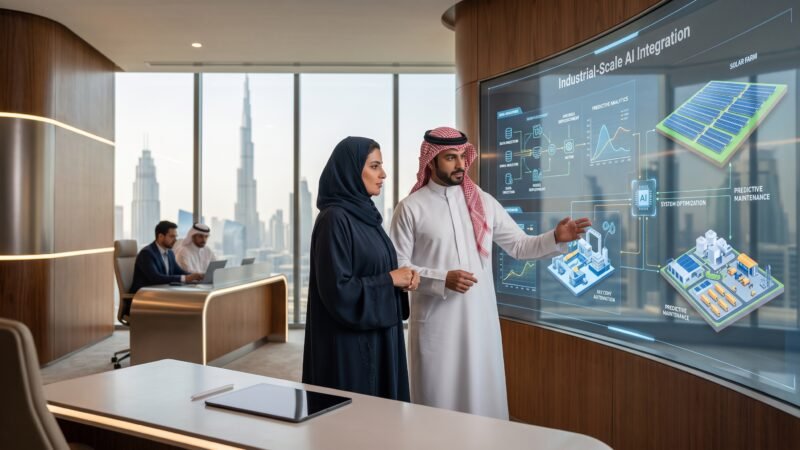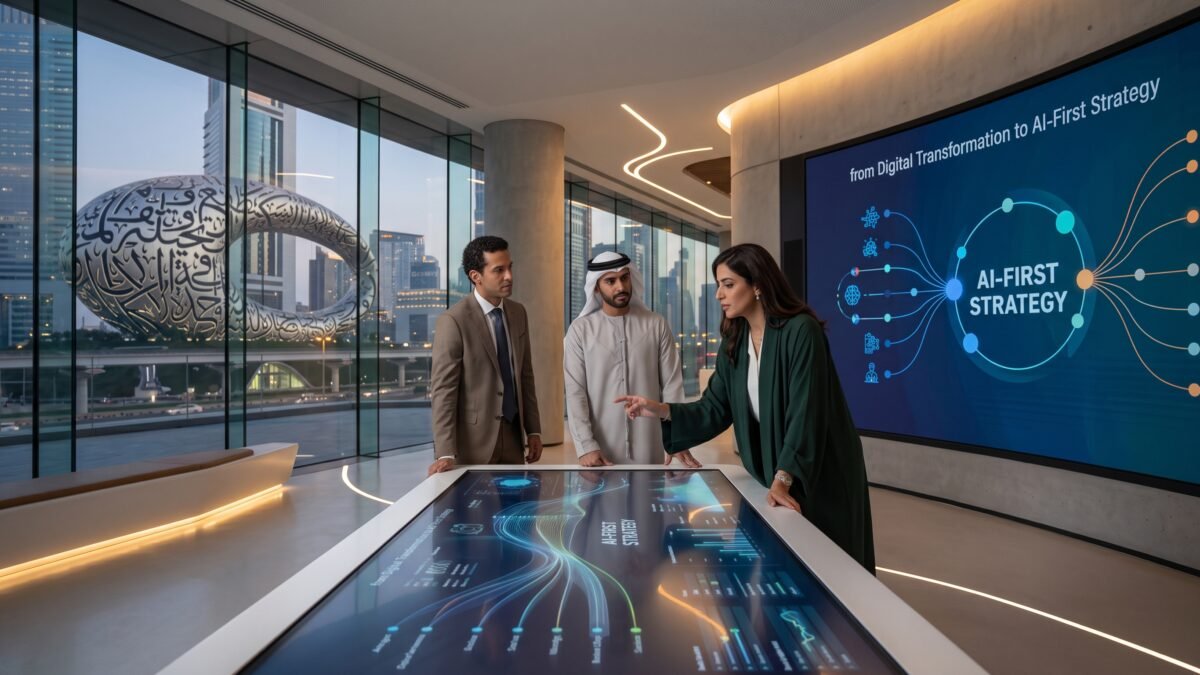
By mid-2026, the conversation across boardrooms in Riyadh, Dubai, and Doha has moved past the experimental phase of generative AI. The era of “pilots” and “proofs of concept” has been replaced by a rigorous, “AI-first” operational reality. For GCC businesses, the adoption of artificial intelligence is no longer a luxury or a speculative tech play; it has become the primary lever for economic diversification and a critical tool for navigating the complexities of the post-oil economy.
The acceleration we are witnessing today is driven by a unique alignment of sovereign wealth, aggressive national visions, and a regulatory environment that has matured rapidly over the last three years. Whether it is a logistics firm in Jebel Ali optimizing its global supply chain in real-time or a retail startup in Kuwait City using hyper-localized Arabic LLMs (Large Language Models) to engage customers, the impact of AI is visible in every layer of the regional economy. This transition is reshaping how companies manage talent, deploy capital, and interact with a consumer base that is among the most digitally savvy in the world.
Sovereign AI and the Drive for Technological Autonomy
One of the most significant trends defining 2026 is the concept of Sovereign AI. Led by the UAE and Saudi Arabia, GCC nations have moved to secure their own computational power and data infrastructure. This is not merely about using global platforms like OpenAI or Anthropic; it is about building and owning the stack. The deployment of massive compute clusters, such as those seen in NEOM and the expansion of G42’s supercomputing capabilities, has allowed the region to reduce its reliance on external tech giants.
For the local business owner, this means access to AI models that understand the linguistic nuances of Khaleeji Arabic, the cultural context of the region, and the specific regulatory requirements of the Saudi Data and AI Authority (SDAIA) or the UAE’s AI Office. Businesses are increasingly moving their workloads to local data centers, driven by a combination of data residency laws and the need for low-latency processing. This infrastructure is the backbone of the “Cognitive Cities” currently coming online, where AI manages everything from traffic flow to energy consumption without human intervention.
Energy and Industry: The Rise of the “Smart Barrel”
The energy sector remains the engine of the GCC, but in 2026, it is an engine managed by algorithms. Major players like Saudi Aramco and ADNOC have integrated AI deep into the upstream and downstream processes. We are seeing the perfection of the “Smart Barrel”—a concept where AI optimizes every stage of production to minimize carbon intensity while maximizing yield.
Predictive maintenance has evolved from a cost-saving measure to a standard operating procedure. Drones equipped with AI-driven computer vision monitor thousands of kilometers of pipelines across the Rub’ al Khali, identifying leaks or structural weaknesses before they manifest. This technological shift is also facilitating the region’s transition to green hydrogen and solar energy. AI systems are now essential for managing the intermittent nature of renewable energy, balancing the grid in real-time to ensure that the massive cooling demands of Gulf summers are met efficiently.
Logistics and Trade: Cognitive Supply Chains
The GCC’s strategic location as a bridge between East and West is being reinforced by AI-driven logistics. In 2026, the ports of Salalah, Khalifa, and Hamad are utilizing “cognitive logistics” to manage the global shipping crunch. AI models now predict port congestion weeks in advance, allowing shipping lines to reroute vessels and optimize fuel consumption.
On the ground, the integration of AI with the regional rail networks and trucking fleets has reduced “empty miles”—the distance trucks travel without cargo. For SMEs involved in trade, this has lowered the barrier to entry for international markets. Automated customs clearance, powered by AI that can verify documents and assess risk in seconds, has turned what used to be a days-long process into a matter of minutes at many regional borders.
Banking and Finance: Hyper-Personalization and Sharia-Compliance
The financial services sector in the GCC has undergone a radical transformation. Traditional banks in Bahrain and Qatar are no longer just competing with each other; they are competing with AI-driven fintechs that offer a level of personalization previously unseen. In 2026, “segmentation” is a dead concept. Instead, banks use AI to offer individualized financial products.
Hyper-personalization means that a small business owner in Muscat might receive a pre-approved credit line offer exactly when their cash flow projections—monitored by the bank’s AI—show a potential dip. In the realm of Islamic Finance, AI is being used to automate the complex compliance checks required for Sharia-compliant contracts, ensuring that every transaction adheres to ethical and religious standards with total transparency.
- Robo-Advisors: These have become the primary wealth management tool for the region’s growing middle class, offering Sharia-compliant investment portfolios tailored to local risk appetites.
- Fraud Prevention: AI systems now detect fraudulent patterns in real-time across cross-border payments, a critical feature as the GCC moves toward a more unified regional payment system.
- Credit Scoring: Alternative data—such as utility payments and social behavior—is being used by AI to provide credit scores for the “unbanked” or newly arrived residents, fostering greater financial inclusion.
The SME Landscape: Democratizing Advanced Technology
Perhaps the most encouraging development in 2026 is how AI has leveled the playing field for Small and Medium Enterprises (SMEs). Previously, only the largest conglomerates could afford high-end data analytics. Today, cloud-based AI tools have made advanced business intelligence accessible to a neighborhood bakery in Riyadh or a boutique creative agency in Dubai Design District.
SMEs are using AI to automate back-office functions—payroll, VAT filing, and inventory management—freeing up founders to focus on growth. In the retail sector, AI-powered sentiment analysis allows small brands to track what customers are saying across social media in real-time, enabling them to pivot their marketing strategies faster than their larger competitors. The “democratization” of AI is a primary reason why we are seeing a surge in non-oil private sector growth across the region.
The Labor Market: Upskilling and the “Nationalization” Challenge
The adoption of AI has brought the regional labor market to a crossroads. There is a palpable tension between the efficiency gains of automation and the national mandates for job creation (such as Saudization and Emiratisation). However, the narrative in 2026 has shifted from “AI replacing jobs” to “AI enhancing the national workforce.”
Governments are investing heavily in re-skilling programs. The goal is to move the local workforce away from administrative roles—which are being automated—and into “AI-adjacent” positions. This includes prompt engineering, AI ethics oversight, and data curation. For businesses, the challenge is finding the right balance. Companies that successfully integrate AI while maintaining a strong commitment to national employment targets are finding themselves in a favorable position with regulators and the public.
“The successful GCC firm of 2026 is one that views AI as a co-pilot for its national talent, not a replacement for it. The focus is on increasing the ‘value per employee’ through technological empowerment.”
Regulatory Maturity and Ethical AI
As AI becomes more pervasive, the regulatory landscape has had to keep pace. In 2026, we see a more sophisticated approach to data privacy and AI ethics. The GCC is not simply adopting Western standards; it is developing a framework that reflects regional values. This includes strict rules on data sovereignty—ensuring that sensitive data about GCC citizens stays within the region—and guidelines on the “explainability” of AI decisions, particularly in healthcare and legal settings.
For international companies operating in the Gulf, compliance is now a complex task. Navigating the differences between Saudi Arabia’s Personal Data Protection Law (PDPL) and the UAE’s federal data laws requires specialized local knowledge. However, this regulatory clarity has also provided the certainty that institutional investors need to pour capital into the region’s tech ecosystem.
The Challenges: Energy, Data Silos, and Cost
Despite the rapid progress, the road to full AI integration is not without hurdles. The first is the environmental cost. AI requires immense amounts of power and water for cooling data centers. In a region where water is scarce and temperatures are rising, the sustainability of large-scale AI infrastructure is under scrutiny. This has led to a surge in “Green AI” initiatives, focusing on liquid cooling technologies and dedicated solar farms for data centers.
The second challenge is data silos. While large corporations have plenty of data, it is often trapped in legacy systems that don’t “talk” to each other. Cleaning and structuring this data for AI use remains a significant expense. Finally, there is the cost of talent. While AI tools are becoming cheaper, the experts who can implement and manage them are in high demand globally. GCC firms are in a global bidding war for top-tier AI researchers and engineers, often competing with Silicon Valley and Singapore.
What Businesses Should Watch Next
As we move toward the second half of 2026, several emerging trends will dictate the next phase of AI adoption in the GCC:
- Edge AI: We will see more AI processing happening directly on devices—such as sensors in oil fields or smart cameras in malls—rather than in the cloud. This reduces latency and improves security.
- AI Governance Officers: Much like the rise of the Data Protection Officer a few years ago, the “AI Governance Officer” will become a standard C-suite or senior management role in GCC firms.
- The “Agentic” Web: We are moving toward a world where AI agents perform tasks on behalf of users—booking travel, negotiating contracts, or managing supply chains autonomously.
- Localized LLMs: Expect to see more “national” language models that are fine-tuned for specific industries, such as a model specifically for UAE maritime law or Saudi construction codes.
Practical Considerations for GCC Executives
For business leaders navigating this landscape, the priority should be strategic integration rather than blanket adoption. It is essential to identify the specific use cases where AI can provide a competitive advantage, whether that is in customer acquisition, operational efficiency, or product innovation.
Investing in “data hygiene” is also critical. An AI is only as good as the data it is trained on, and for many Gulf firms, the immediate task is to break down internal silos and create a unified data architecture. Furthermore, fostering a culture of “AI literacy” across the organization—from the boardroom to the front line—is the only way to ensure that the technology is embraced rather than feared.
The Investment Perspective
From an investment standpoint, the GCC is no longer just a source of capital for global tech; it is a destination for it. Venture capital is flowing into local AI startups that are solving regional problems. For investors, the opportunity lies in companies that are building “middle-ware”—the tools that help traditional businesses integrate AI into their existing workflows. The real value in 2026 is not in the AI models themselves, but in their application to the specific challenges of the Gulf’s core industries.
Conclusion
The reshaping of the GCC business landscape by AI is a profound shift that touches every sector from the oil fields of the Eastern Province to the high-rises of Dubai International Financial Centre. In 2026, the competitive divide is widening between those who have successfully integrated AI into their core strategy and those who still view it as a peripheral IT project.
For businesses, investors, and professionals, the main takeaway is clear: the “wait and see” approach is no longer viable. The infrastructure is in place, the regulations are maturing, and the capital is available. The next eighteen months will likely determine the market leaders for the next decade. Those who prioritize sovereign data, local talent development, and ethical AI implementation will be the ones who define the future of the Gulf’s digital economy. The focus now must be on scaling these technologies responsibly to ensure they contribute to the long-term goals of national diversification and sustainable growth.