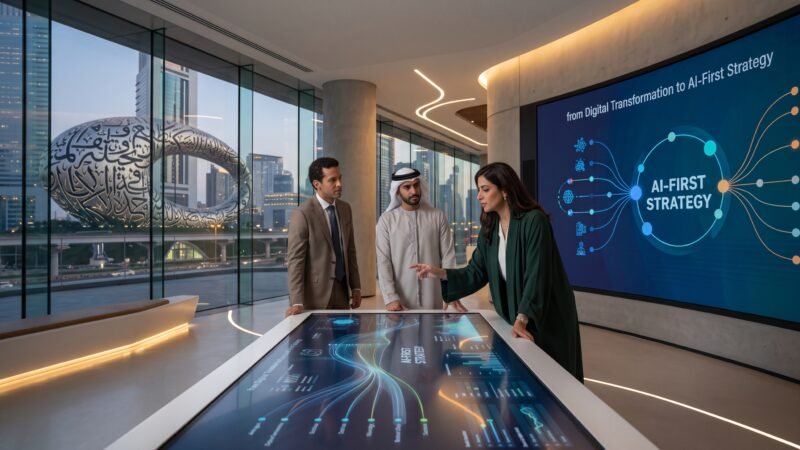
As we navigate the middle of 2026, the conversation surrounding artificial intelligence in the United Arab Emirates has undergone a fundamental transformation. The era of speculative pilot programs and experimental “sandboxes” has been replaced by a period of massive, structured capital deployment. For businesses operating within the GCC, particularly those looking toward the UAE as a hub for innovation, the landscape is no longer defined by what AI *might* do, but by the physical and digital infrastructure the state has built to ensure it *must* work.
The UAE’s investment strategy has pivoted toward “Sovereign AI”—the concept that a nation must own its data, its compute power, and its algorithmic frameworks to ensure economic independence. For a business journalist covering the Gulf, the most striking development in 2026 is how this top-down investment is creating a “trickle-down” effect for the private sector. From the launch of MGX, the technology investment titan, to the continued evolution of G42 and the Mohamed bin Zayed University of Artificial Intelligence (MBZUAI), the UAE is positioning itself as the primary landlord of the region’s AI ecosystem.
For CEOs and founders, this means that the strategic growth opportunities are no longer found just in “using AI” to automate emails. Instead, they lie in the integration of business models into a localized, high-performance computing environment that is increasingly insulated from global supply chain shocks and geopolitical volatility.
Strategic Anchors: The Role of MGX and G42 in 2026
To understand where the growth opportunities lie, one must first look at the entities directing the flow of capital. By 2026, MGX has established itself as one of the world’s most influential specialized investment firms, focusing on AI infrastructure, semiconductors, and core software. This isn’t just a government fund; it is a signal to the global market that Abu Dhabi is prepared to anchor the physical reality of AI.
For businesses, this creates a secondary market of opportunity. When the UAE invests billions into local data centers and chip design partnerships, it lowers the latency and cost for local enterprises. We are seeing a surge in specialized startups that are building “on top” of these state-funded foundations. Rather than relying on generic models hosted in North America or Europe, UAE-based firms are increasingly utilizing localized Large Language Models (LLMs) like the Falcon series, which are optimized for regional dialects, cultural nuances, and specific regulatory requirements.
The partnership between G42 and global giants like Microsoft and OpenAI has matured. In 2026, this has resulted in a unique “dual-stack” environment where businesses can access global cutting-edge tools while keeping their sensitive data within the UAE’s physical borders. This is a critical growth lever for sectors like healthcare, defense, and finance, where data residency is a legal prerequisite.
The Energy-AI Nexus: Powering the Next Decade
One of the most significant, yet often overlooked, strategic opportunities in 2026 is the intersection of energy and AI. The UAE has recognized that AI is an energy-hungry beast. Consequently, we are seeing a massive alignment between the Abu Dhabi National Oil Company (ADNOC), Masdar, and AI developers.
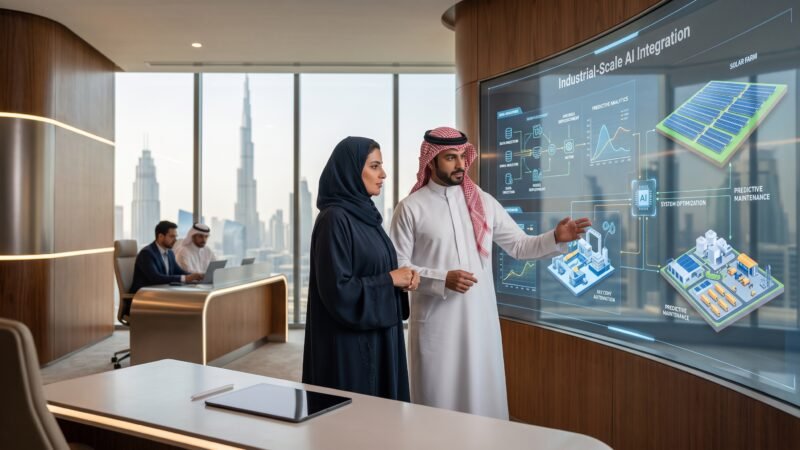
Strategic growth for industrial players now involves “Energy-Aware AI.” Businesses that can provide cooling technologies, modular data center solutions, or renewable energy integration for AI clusters are finding themselves in high demand. ADNOC’s use of AI for predictive maintenance and carbon capture optimization has set a blueprint for the region. In 2026, the opportunity for SMEs lies in providing the specialized sensors and edge-computing hardware that feed these massive industrial AI systems.
This isn’t limited to the oil and gas sector. In Dubai, DEWA (Dubai Electricity and Water Authority) has integrated AI to a point where the grid is essentially self-healing. For real estate developers and construction firms, the opportunity lies in building “AI-ready” smart buildings that can plug directly into this intelligent grid, reducing operational costs and meeting the UAE’s stringent Net Zero 2050 targets.
Financial Services and the ADGM/DIFC Corridor
The financial hubs of Abu Dhabi Global Market (ADGM) and Dubai International Financial Centre (DIFC) are no longer just regulatory bodies; they are now active participants in the AI investment cycle. In 2026, we are witnessing the rise of “AI-Native Finance.”
For fintech startups and established banks, the UAE’s investments have paved the way for:
- Hyper-Personalized Wealth Management: AI models that analyze local market trends, real estate fluctuations, and global oil prices to provide real-time investment advice for the GCC’s high-net-worth individuals.
- Automated Regulatory Compliance (RegTech): As the UAE updates its data protection and AI ethics laws, businesses that provide automated compliance tools are seeing exponential growth.
- Fraud Detection: With the UAE being a global crossroads for trade, AI-driven anti-money laundering (AML) tools have become a mandatory part of the business infrastructure, creating a massive market for cybersecurity firms.
The strategic advantage here is the “regulatory clarity” provided by the UAE government. Unlike other regions that are still debating the basics of AI oversight, the UAE has implemented a framework that balances innovation with risk, giving investors the confidence to deploy capital.
SME Integration: Beyond the Corporate Giants
A common misconception in previous years was that AI investments would only benefit the state-owned enterprises or the multi-billion-dollar tech firms. In 2026, the reality is quite different. The UAE’s National Strategy for AI 2031 has effectively pushed resources toward the SME sector.
Small and medium enterprises are finding growth by adopting “Vertical AI.” Instead of trying to build a general-purpose chatbot, a small logistics firm in Jebel Ali is now using a specialized AI tool designed specifically for Middle Eastern supply chain routes, taking into account seasonal weather patterns, regional customs bottlenecks, and local labor laws.
The availability of AI-as-a-Service (AIaaS), hosted on local clouds like G42’s Core42, has lowered the barrier to entry. A retail startup in Sharjah can now utilize computer vision to track inventory and customer behavior with the same sophistication as a global conglomerate, but at a fraction of the cost. The strategic opportunity for entrepreneurs is to identify these “micro-niches” where localized AI can solve specific regional pain points.
The Talent War and the “Golden Visa” Evolution
Investment isn’t just about hardware and software; it is about “brainware.” In 2026, the UAE’s aggressive talent acquisition strategy is paying dividends. The Golden Visa program has evolved to specifically target AI researchers, data scientists, and prompt engineers.
For businesses, this means the UAE now possesses one of the highest concentrations of AI talent per capita in the world. However, this has also created a challenge: a highly competitive labor market. Strategic growth now requires companies to invest in internal upskilling. We are seeing a trend where traditional firms are partnering with MBZUAI to create custom training programs for their staff.
The opportunity for professional services firms—consultants, trainers, and recruiters—is immense. There is a constant need to bridge the gap between the high-level AI infrastructure being built by the state and the practical, day-to-day operations of a standard business.
Regional Dynamics: Cooperation and Competition
While the UAE is a leader, it does not exist in a vacuum. The broader GCC context in 2026 is one of “cooperative competition.” Saudi Arabia, through its Public Investment Fund (PIF) and the National Center for AI (SDAIA), is making equally massive strides.
For a business operating in the region, the strategy should be to leverage the unique strengths of each market:
- The UAE remains the primary testing ground and the hub for international collaboration and “sovereign” infrastructure.
- Saudi Arabia offers the sheer scale of the domestic market and massive giga-projects like NEOM, which act as a giant laboratory for AI-integrated urban living.
- Qatar is focusing heavily on AI in sports technology, media, and liquefied natural gas (LNG) optimization.
- Bahrain and Oman are carving out niches in AI-driven fintech and logistics, respectively, often offering more cost-effective entry points for startups.
The strategic growth opportunity lies in “Cross-Border AI.” Businesses that can create AI solutions that work seamlessly across the different regulatory environments of the GCC will be the true winners. For example, an AI-driven payroll system that automatically adjusts for the specific labor laws and tax requirements of both the UAE and Saudi Arabia is a high-value product in 2026.
The Risks: Navigating the 2026 AI Landscape
It would be remiss for any serious business journalist to ignore the risks. The UAE’s rapid AI investment has created specific challenges that businesses must navigate:
1. The “Black Box” Liability: As AI takes over more decision-making in sectors like finance and healthcare, the question of legal liability becomes paramount. If an AI makes a catastrophic error in a medical diagnosis in Dubai, who is responsible? Businesses must invest in “Explainable AI” (XAI) to ensure they can justify their automated decisions to regulators.
2. Cybersecurity Threats: The more a nation invests in AI, the more it becomes a target for sophisticated, AI-driven cyberattacks. In 2026, cybersecurity is no longer an IT expense; it is a core business strategy. The UAE’s Cyber Security Council has been proactive, but the onus remains on individual businesses to protect their data.
3. Ethical and Cultural Bias: Many AI models are still trained on Western datasets. Businesses in the GCC face the risk of deploying AI that does not understand the local cultural context, leading to brand damage or social friction. Investing in “culturally aligned” AI is not just an ethical choice; it is a business necessity for those targeting the local population.
4. The Cost of Obsolescence: The pace of AI development is so fast that hardware or software purchased in 2024 may be obsolete by late 2026. Strategic growth requires a “flexible architecture” approach—avoiding vendor lock-in and ensuring that systems can be easily updated as new models emerge.
Practical Steps for GCC Businesses in 2026
For those looking to capitalize on the UAE’s AI investments, the following steps are increasingly seen as the standard for success:
- Audit the Data Foundation: AI is only as good as the data it consumes. Many GCC firms are finding that their first “AI” project is actually a massive data-cleaning project. Strategic growth starts with structured, high-quality, and locally hosted data.
- Leverage Local Clouds: To comply with evolving data residency laws in the UAE and Saudi Arabia, businesses should move away from generic global cloud providers and toward regional players that offer “Sovereign AI” capabilities.
- Focus on ROI, Not Hype: In 2026, investors are no longer impressed by the word “AI.” They want to see specific metrics: a 20% reduction in operational costs, a 15% increase in customer retention, or a 30% faster time-to-market.
- Engage with the Ecosystem: Growth doesn’t happen in isolation. Businesses should actively participate in the various AI districts, such as Dubai’s AI Campus at DIFC or the various tech hubs in Masdar City. These are the places where the next round of government grants and partnership opportunities are announced.
The Road Ahead: What to Watch in Late 2026
As we look toward the end of 2026 and into 2027, the focus of UAE AI investment is expected to shift toward Physical AI—the integration of LLMs into robotics and autonomous systems. We are already seeing the first wave of AI-driven delivery drones and autonomous maintenance robots in the streets of Dubai and Abu Dhabi.
Furthermore, the “AI for Sustainability” movement will gain even more momentum. With the UAE hosting major global climate dialogues and maintaining its Net Zero commitments, any AI project that can demonstrate a clear reduction in carbon footprint will likely receive preferential treatment in terms of funding and regulatory approvals.
The UAE has successfully moved past the stage of simply being a consumer of technology. Through strategic, multi-billion-dollar investments, it has become a creator and a landlord of the AI future. For businesses, the opportunity is no longer about finding the right AI; it is about finding their place within the sophisticated, sovereign ecosystem the UAE has built.
Conclusion: The Strategic Imperative
The UAE’s AI investments have fundamentally rewritten the rules of business growth in the GCC. By 2026, the primary advantage for a company based in the Emirates is no longer just the tax-free environment or the strategic geographic location—it is the access to a world-class, sovereign AI infrastructure.
The businesses that thrive will be those that stop viewing AI as a “tech project” and start seeing it as the core utility of the modern economy, much like electricity or the internet. The strategic growth opportunities are vast, ranging from industrial optimization and financial innovation to the creation of entirely new, AI-native service sectors.
However, the window for early-mover advantage is closing. As the infrastructure matures, the barrier to entry will rise. For investors, entrepreneurs, and established professionals, the message for 2026 is clear: the infrastructure is ready, the capital is deployed, and the talent is in place. The next phase of growth will belong to those who can translate these national investments into practical, scalable, and ethically sound business solutions. Watch for the rise of specialized, industry-specific LLMs and the further integration of AI into the GCC’s physical infrastructure as the next major trend to define the late 2020s.